

If you are new here, don’t forget to check our Discord Channel. It’s free for everyone!
If you like my work and are interested in more high-level Jeskai Energy Blink content, consider checking my other articles, including the sideboard guide here!
Introduction
What is Jeskai Energy Blink?
Jeskai Energy Blink (also called Jeskai Quantum Energy) is an attempt to merge two powerful Modern archetypes, Energy and Jeskai Blink, into one contraption that hopefully will retain all the strengths of its parts while mitigating some of the flaws. Jeskai Blink was first seen at PT Edge of Eternities, piloted by Matt Costa, yet only a couple months later, at the US Regional Championship (RC) Houston, it was one of the most popular and successful decks at that tournament, including taking down the whole event in the hands of Vinnie Fino. However, the European RC in Antwerp has proven that Modern can change rapidly, adapting to the new “deck to beat”. Decks like Boros Energy, Izzet Prowess and Simic Ritual came prepared for the best deck, changing the modern landscape. And here our history begins.
Jeskai Energy Blink is a “smaller” cousin of Jeskai Blink, which abandons maindeck countermagic, Teferi, Time Raveler and sweepers, and focuses more on early game. With the addition of powerful one drops in Guide of Souls and Ocelot Pride, the deck can execute its own aggressive plan, develop early board presence and survive against fastest aggro decks of the format. The combination of fast openings with powerful lategame (mostly due to Phelia, Phlage, Quantum Riddler and Solitude) is difficult to overcome for many decks of the format.
Decklist
You can download the decklist in the text form here.
If you can’t see decklists and links, it’s likely because you didn’t accept cookies. Doing so is mandatory for the website to work correctly.

Why should you play it over both classic energy and other blink builds?
Jeskai Energy Blink is built to beat aggro decks while maintaining lategame power. It preys on classic Boros Energy by having better lategame threats and removal. Between Guide of Souls, Ocelot Pride and Phlage, we have enough lifegain, removal and board presence to fight any aggressive deck in Modern, which is undoubtedly valuable in the contemporary Modern. Between Boros Energy, Izzet Prowess and Affinity, many games might be over as soon as turn 2 or 3. Jeskai Energy Blink has the best chance to stop those decks by either stalling the game and winning later, or simply by developing its own, bigger board.
Strengths
Early board presence, great matchup against aggro, free wins from Guide of Souls +
Ocelot Pride, ability to go into lategame leveraging blink effects + Quantum Riddler. It also has the option to transform into a Jeskai Control postboard, by cutting all one drops in the favour of countermagic, sweepers and Teferi, Time Raveler.
Weaknesses
The current version of the deck struggles against Goryo’s Vengeance and decks with better top end, like various Eldrazi decks. We can adjust our sideboard to have a better matchup against them, but each of them requires different tools, but since they are not too popular at the moment, we can’t devote too many sideboard slots for it.
Primer
The main gameplan and major deckbuilding decisions
The gameplan depends on your starting hand and your matchup. Or rather the other way around – your matchup and your starting hand. The deck can go in two directions: First one is a fast opening, usually involving Guide of Souls and Ocelot Pride, less often a fast Phlage attack. The other is a classic value approach, focused on Phelia, Seasoned Pyromancer, Phlage and Quantum Riddler. Having two quite different plans in one deck is valuable, but also tricky to navigate. You can apply early pressure and back it up with Quantum Riddler to “reload” and finish your opponent, but on the flip side you can draw a bunch of Guide of Souls in the late game, which is much less appealing. Of course, these one drops can be pitched to Solitude, discarded with Pyromancer or just put on board to empty the hand for incoming Quantum Riddler, but the navigation through those situations requires some experience.
Why did I say that our strategy is matchup dependent? If you know that you are playing against Affinity, you want to aggressively mulligan to find Guide of Souls, Ocelot Pride and removal for Pinnacle Emissary, rather than keeping Phlage, Titan of Fire’s Fury and Quantum Riddler for lategame. Similarly, if you face Jeskai or Esper Blink you don’t want too many one drops. Mulliganing to more value is usually a good decision, as you have the ability to refill it later.
One drops – Guide of Souls and Ocelot Pride
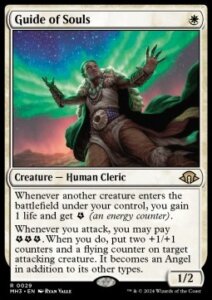
This is the most efficient two card combo to fight aggro decks. We can gain enough life to survive against Boros Energy, Izzet Prowess and Affinity, while developing a board big enough to kill our opponent. Why don’t we just play Boros Energy, or run more one drops if they are so good? First of all, not every matchup can be won with a fast clock. Our version of the deck can go into lategame, and we are not as vulnerable to sweepers as Boros Energy. On top of that, Ragavan is often quite bad against opposing Ocelot Pride, Lava Dart, multiple cheap blockers from Affinity, etc. Our one drops have a nice synergy with Phelia, Phlage and Solitude. We want to have early board presence, not to become an aggro deck.
Quantum Riddler and the ways to get it into play
Riddler is close to synonymous with lategame in Modern. Its advantages are obvious – big body, evasion, drawing extra cards, flexibility at casting it and being strong and virtually at every point in the game. Most of the time, we want to cast Phelia, untap, warp Quantum Riddler and blink it with Phelia’s trigger to get extra draw and 4/6 body for free. Alternatively, we can use Ephemerate to achieve a similar effect. Remember that casting Ephemerate with draw ability on the stack also empties your hand. Sometimes you might even want to evoke Solitude to remove a creature which is not crucial for your opponent, just to empty your hand and draw more cards. Sometimes it is better to wait with Quantum Riddler to get more value with its trigger.
Other value cards (Phlage, Seasoned Pyromancer)
Phlage provides a bit of everything – removal, lifegain, value. It synergizes nicely with Guide of Souls and Ocelot Pride. It also somewhat works with Ephemerate, albeit it’s not a great pairing, but sometimes you can blink it just to deal more damage. The option to escape it on a later turn makes us favourite in many long games.
Seasoned Pyromancer is sort of a new addition, as I used to play Fable of the Mirror Breaker in this slot. While both cards have their pros, Seasoned Pyromancer works better with Guide of Souls, Ocelot Pride and Phlage, and can be blinked with Ephemerate and Phelia to give us even more cards, with better card selection as well. Lastly, it can create extra bodies once it dies. Obviously treasure tokens from Fable can help us escape from under Blood Moon, but Boros Energy is already a good matchup. Reflection of Kiki-Jiki can easily dominate the lategame by copying Solitude or Quantum Riddler, but I rarely had an option to untap with the Reflection, thus I value Pyromancer more.
Removal
Between Galvanic Discharge, Phlage and Solitude we have an answer to most of the threats in the format. Red color provides an answer to planeswalkers which I really missed in Esper Blink. Our Galvanic Discharge is not as good as in Boros Energy, as we don’t have Static Prison and we often cut Guide of Souls postboard. That being said, we can still amass some energy over the course of the game and kill some larger creatures.
Postboard, we can bring additional removal spells. Currently I play a couple copies of Prismatic Ending and Wrath of the Skies, but there are plenty more options for any kind of permanents. Don’t hesitate to change your sideboard removal choice if your metagame forces you to do so. Too many big mana decks? Go for Obsidian Charmaw. Tired of losing to red based decks? Put it a couple copies of Celestial Purge. Urza’s Saga is bothering you? March of Otherworldly Light and Wear / Tear are there for you.
The manabase
Surveil lands are the key to setting up the top of your deck. I know it slows the deck down, but the benefits are too big not to play them. Run three copies, one for each color pair. We play 1 Mountain, 1 Island and 2 Plains to have protection against Blood Moon and Harbinger of the Seas. We also need to be able to fetch basics, as lifeloss might be relevant against aggro. Due to a total 8 white 1-drops, we can’t play too many Arena of Glory. I cut them down to 2 copies, as it can close games quickly with escaped Phlage or Quantum Riddler. Remember that you can use mana from Arena to haste two creatures using one “hasty” mana to pay for each of them! Once we add fetchlands, the manabase is done. Since white is the primary color of our deck, Flooded Strand and Arid Mesa get the nod over Scalding Tarn.
Sideboard options
Consign to Memory – why not an auto four-off?
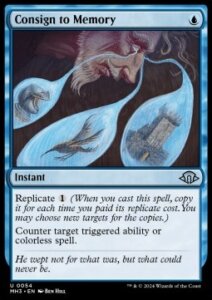
Consign to Memory is a great card, and there were times when it was the most played card in Modern. But recently, there are simply not enough relevant targets for it. Eldrazi Tron disappeared, Broodscale is not too popular and we can fight it with different cards, and Eldrazi Ramp is barely playable. Because of that, I’d rather focus on Ephemerate, at least maindeck-wise, as it simply synergizes better with our cards and provides more value. Our sideboard has only fifteen slots and we need to be prepared to fight various strategies including fast combo, graveyard based decks and other Blink decks ready to fight us in the lategame. You can’t prepare for everything, so be prepared for the most popular strategies, which currently don’t include colourless decks.
Other countermagic (Strix Serenade, Mystical Dispute, etc.)
First of all, we don’t want heavy blue cards, so no Counterspell allowed. We also can’t utilize Flare of Denial and Force of Negation due to only splashing blue. Among countermagic with single blue mana in the cost, the most appealing are:
- Mystical Dispute: absolutely key against Teferi, Quantum Riddler, opponent’s countermagic, Emry, Pinnacle Emissary, Kappa Canoneer, and many others.
- Strix Serenade: tags most of the above plus artifacts and all planeswalkers; the drawback is real as a 2/2 flyer can stop our Ocelot Pride, kill Teferi and so on. But its cheap cost and versatility is more important. We can mitigate this drawback nicely by removing the token with Phelia, killing it with Phlage or bouncing it with Teferi.
- Consign to Memory – semi-counterspell, used also against triggered abilities. In the proper environment this is an absolute all star card. I simply think that it’s not that good in the current metagame.
- Flusterstorm – currently not too useful in Modern.
- Spell Pierce – rather too weak and situational for our gameplan.
I recommend choosing some combination of Consing to Memory, Strix Serenade and Mystical Dispute. These cards can cover most of the threats and strategies currently playable in Modern. Keep the other possible choices in mind if you want to prepare against other decks.
Wrath of the Skies
The weapon of choice against creature decks and all sorts of permanents. By far the best sweeper in the format which cleans the board of Urza’s Saga, Cori-Steel Cutter, Goblin Bombardment and many other noncreature threats. Don’t worry about your own creatures, as Wrath will often be game winning even if it ends up killing a few of your creatures. Moreover, we often cut some one drops in matchups where Wrath of the Skies is coming in, e.g. against Boros Energy or Broodscale.
Teferi, Time Raveler
An absolutely key card in the mirror, and even more important against BW or Esper. Teferi gives you the option to blink your creatures uncontested while stopping your opponent with countermagic, Consign to Memory or Solitude. It is also a great card against control and various combo decks. It can be reset with Phelia and generate card advantage for multiple turns.
High Noon
With the recent rise of Storm, we need to have some hate against it. Besides graveyard hate and removal, which can slow this deck down, we need some dedicated hate. Drannith Magistrate is not that popular anymore as it only punishes Storm. If big mana gets more popular, we can consider Damping Sphere, but currently Izzet Prowess is a tier 1 deck and High Noon happens to be great against them.
Graveyard hate
Modern graveyard hate cards is an endless topic. There are tons of them, so you just need to ask yourself a question: which decks do you want to beat? Recently Boros Energy has become more popular, becoming once again the “deck to beat” in Modern. Phlage is probably the most juicy target for graveyard hate. Izzet Prowess uses a graveyard to some extent, as well as some Affinity builds (if they play Emry) but this is a marginal part of their gameplan. If we focus on Phlage, we can opt for Ghost Vacuum, Surgical Extraction or Soul-Guide Lantern. There are plenty of other choices but those are cheap, flexible and provide some sort of extra value. I’ve chosen Soul-Guide Lantern as it deals with Phlage on ETB and provides a redraw later. In contrast to Ghost Vacuum and Surgical Extraction, it has the ability to stop Storm the turn they go off. Obviously there are some pros of Surgical Extraction against e.g. Goryo’s Vengeance, but as I mentioned above – you need to decide which decks/strategies you want to hate out. I tend to tweak my sideboard from day to day, so expect updates in my list. And don’t hesitate to experiment yourself too!
Gameplay tips
Tips and tricks
- Phelia can blink all sorts of permanents. Quantum Riddler is the most juicy target, but Seasoned Pyromancer is also a nice one. You can blink Guide of Souls just to get a counter on Phelia. However, be careful with blinking Ocelot Pride, as it won’t make any tokens! It comes back in the end step, and it won’t trigger even if you’ve gained life this turn. Blinking Teferi resets him, so you use the minus ability again next turn to draw an additional card.
- You can blink your opponent’s permanent with Phelia just to push damage through or kill tokens. Keep that in mind and consider your options. There are more tricky situations where you can use this trigger to your advantage, like exiling Leyline of the Guildpact and casting evoked Solitude to get rid of Scion of Draco, or removing Goblin Bombardment so your opponent can’t chumpblock and ping you or your creatures, etc.
- You can cast Consign to Memory targeting Phelia’s trigger, so the exiled card never comes back.
- You can Consign to Memory the sacrifice trigger of Phlage in order to keep it on the battlefield.
- Exert Arena of Glory and use one red mana to cast one creature, and one red mana to cast another creature. This way they both gain haste.
- Solitude and Ephemerate give you a bunch of life with Guide of Souls.
- Galvanic Discharge with energy from Guide of Souls is a hard removal for almost any creature in the format. You can also cast it targeting your own creature just to gain energy and pump your creature with Guide. The energy reservoir is important, keep your eye on it.
- You don’t have to cast your one drops on turn one. Depending on the matchup and the situation, it might be better to wait and gain more value later. Open red mana from Izzet Prowess turn one? Maybe they are waiting with Lightning Bolt or Lava Dart. Just be patient and get a surveil land on turn one, as they often tap out on turn two. You can then cast both Guide of Souls and Ocelot Pride on turn two and get at least some value in.
- Keep eye on your City’s Blessing and count the number of tokens properly. This is not always trivial, so do not rush with that!
- Evoked Solitude is a cheap extra card for Phlage’s escape. Keep that in mind, as you might be able to surprise your opponent this way.
- Ephemerate is not only a great card to multiply ETB effects, but also a protection spell. Sometimes it is worth saving Guide of Souls or Ocelot Pride just to keep them on board and build the pressure.
The most frequent gameplay questions
Aggro or Midrange? You need to evaluate your hand based on the matchup. Against an unknown opponent, I would never mulligan a functional hand with Guide of Souls and Ocelot Pride. That being said, against any Blink deck the clock is not the way to win. On the other hand, Ephemerate, Phelia, Exuberant Shepherd and Quantum Riddler are way too slow against Affinity. You rather mulligan to five and look for cheap removal against Pinnacle Emissary, Guide of Souls and Ocelot Pride.
Mulligans are not too painful as we can refill our hand easily with Quantum Riddler and Seasoned Pyromancer. Don’t be afraid to do it if you know what you are looking for. In my experience, non-removal hands against Boros Energy often amount to a loss in the matchup. Opened a nice double Quantum Riddler plus Ephemerate hand? I’d mulligan it, especially on the draw.